
From 48-Hour Turnaround to Real-Time Insights: Quantifying AI’s Impact on RFP Response Times
Introduction
Earlier this year, our ApolloRise team partnered with a mid-sized hotel group to tackle a familiar challenge: responding to Requests for Proposals (RFPs) faster and more efficiently. In an industry where event planners often send RFPs to multiple venues at once, a slow reply can mean lost business. In fact, 42% of event planners expect a reply within 48 hours (MICE sourcing volume on track to exceed pre-pandemic numbers by more than 17% ) – a benchmark many mid-sized companies struggle to meet, especially as meeting and event (MICE) RFP volumes have rebounded above pre-pandemic levels (MICE sourcing volume on track to exceed pre-pandemic numbers by more than 17% ).
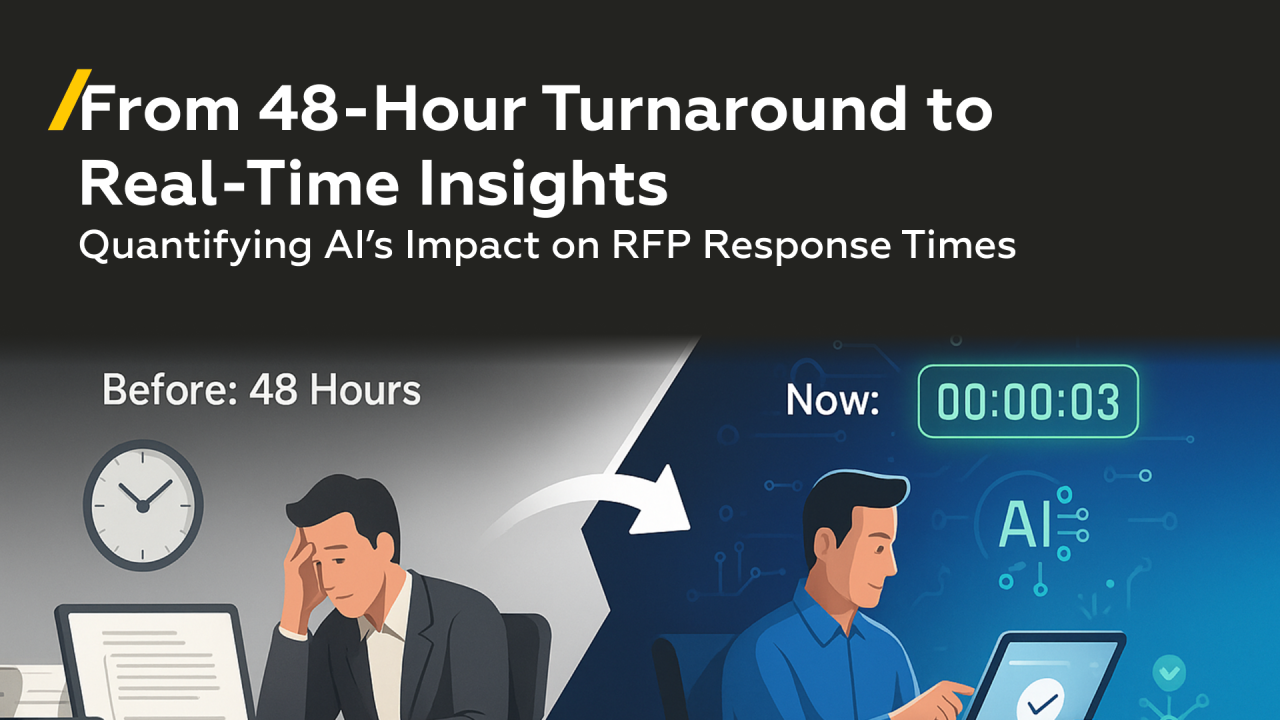
At this hotel group, the average turnaround was about two days (~48 hours), meaning they were just barely meeting many clients’ minimum expectations and sometimes falling short. Every extra hour carried the risk that a lead would go cold or choose a competitor. Leadership knew that if they could respond faster – ideally within the same day – they could handle more RFPs per week and improve their chances of winning deals.
This article shares how integrating AI into Microsoft Teams (with Azure services) was designed to transform that 48-hour turnaround into near real-time responses. We’ll quantify the potential impact with data-driven projections and industry research, discuss the hurdles (security and policy concerns were big ones), and distill key takeaways for executives considering similar AI enhancements.
The 48-Hour RFP Response Challenge
Every RFP is an opportunity – and a ticking clock. The hotel group’s sales team manually crafted each response, gathered answers from past proposals, and recalculated quotes from scratch. This often meant toggling between multiple systems (CRM, email, a revenue management tool, external RFP portals) and involving several departments to collect all the needed information. A thorough response could take hours or even days of work. This is consistent with industry trends: one study found writing a single RFP response can consume around 25 hours on average (46 RFP Statistics on Win Rates & Proposal Management). Meanwhile, speed matters because meeting planners typically reach out broadly: on average, they send an RFP to 10 different venues, and responding late (or not at all) can drive valuable business to competitors. In our case, a ~48-hour turnaround meant we were just meeting the minimum expectation of many planners (MICE sourcing volume on track to exceed pre-pandemic numbers by more than 17% ) and sometimes missing the mark.
“If we can reduce that chunk of time where people are just plugging questions and answers in and doing a search one by one, then we can focus much more time on the strategy.” – Carrie Jordan, former Global Director of Proposals at Microsoft
This insight from Microsoft rings true across industries. Our goal was to free the hotel’s team from the grunt work of compiling RFP answers, so they could concentrate on tailoring proposals and strategy. Achieving this meant re-engineering the process with AI-driven automation without compromising quality or accuracy.
Designing an AI-Powered RFP Response System
We designed an AI-assisted RFP response system integrated into the hotel’s existing workflow, mainly Microsoft Teams (to fit how employees already collaborate) , with Azure’s AI services on the backend. The concept was straightforward: when an RFP came in (whether via Outlook email or a platform like Cvent/MeetingPackage), an AI assistant could auto-generate a first draft of the proposal by pulling answers from the company’s internal data, approved templates, and knowledge bases, all in seconds. This draft would then be reviewed and refined by the sales team before sending. The system architecture combined a few key components:
- Knowledge Integration: We fed the AI with the hotel’s internal content – past RFP responses, pricing sheets, fact sheets about each property, CRM records, and standard templates. This created a private knowledge base from which the AI could draw. According to industry experts, having a centralized content library is crucial; the best platforms can even pre-populate repetitive questions with approved answers. Our approach mirrored that idea, ensuring the AI’s answers were accurate and on-brand instead of hallucinating facts from the open web. We also connected relevant data sources (like the IDeaS revenue management system for up-to-date pricing and availability) so the AI had the latest information at hand.
- Generative Drafting: Using Microsoft Azure’s OpenAI service, the bot could answer RFP questions in natural language. Our solution was designed to complete the bulk of an RFP’s Q&A section in a few minutes. In effect, the AI could handle roughly 80% of a first draft automatically. Industry research shows this level of automation is feasible – for example, one company’s AI-driven proposal platform now generates first drafts 10x faster, enabling them to submit 67% more proposals without additional headcount (Responsive Named Leader in Aragon Research Globe for Strategic Response Management, 2025). Our prototype aimed for similar efficiency, having the AI fill in standard details (e.g., venue capacity, A/V capabilities, pricing tiers) and even compose personalized intro and closing statements based on the RFP’s context.
- Teams Integration (and Adaptability): Users interacted with the AI through Microsoft Teams. We built a Teams chatbot where a sales manager could upload a new RFP document or message the bot with key details, and the bot would respond with a draft proposal or answers. This made adoption easier – no one had to learn a new tool. (For companies using Slack or web portals, a similar bot could be deployed there just as easily; the AI logic remains platform-agnostic.) The bot could also proactively send alerts or ask clarifying questions if needed, mimicking a collaborative colleague. Crucially, the assistant was integrated with existing systems (CRM, Outlook, etc.), so it fit into the team’s natural workflow. For example, an RFP email forwarded to the bot would trigger an AI-generated reply draft in Teams, eliminating the need to switch between the inbox, CRM, and other apps.
- Predictive Analytics Dashboard: Beyond just drafting responses, we added a dashboard to track response times, proposal quality metrics, and even forecast the team’s capacity. By analyzing historical data, the system could predict busy RFP periods (for instance, an influx of event RFPs every Q4) and suggest when to automate more versus involve human experts. This predictive element helped quantify the AI’s impact in real time and made it easier to report results to executives. Over time, it could evolve into a live “RFP insights” portal – showing, for example, how many proposals are in progress, average turnaround this week, and which deals might need extra attention.
From 48 Hours to Real-Time: Quantifying Time Savings
The most dramatic payoff we targeted was in response speed. With the old process, the hotel’s average RFP response took ~48 hours (and even longer for complex requests). With AI generating a solid first draft in minutes, that timeframe shrinks significantly. Our projections showed that once the system was fully implemented, same-day responses would become the norm, with many proposals turned around in just a few hours or less.
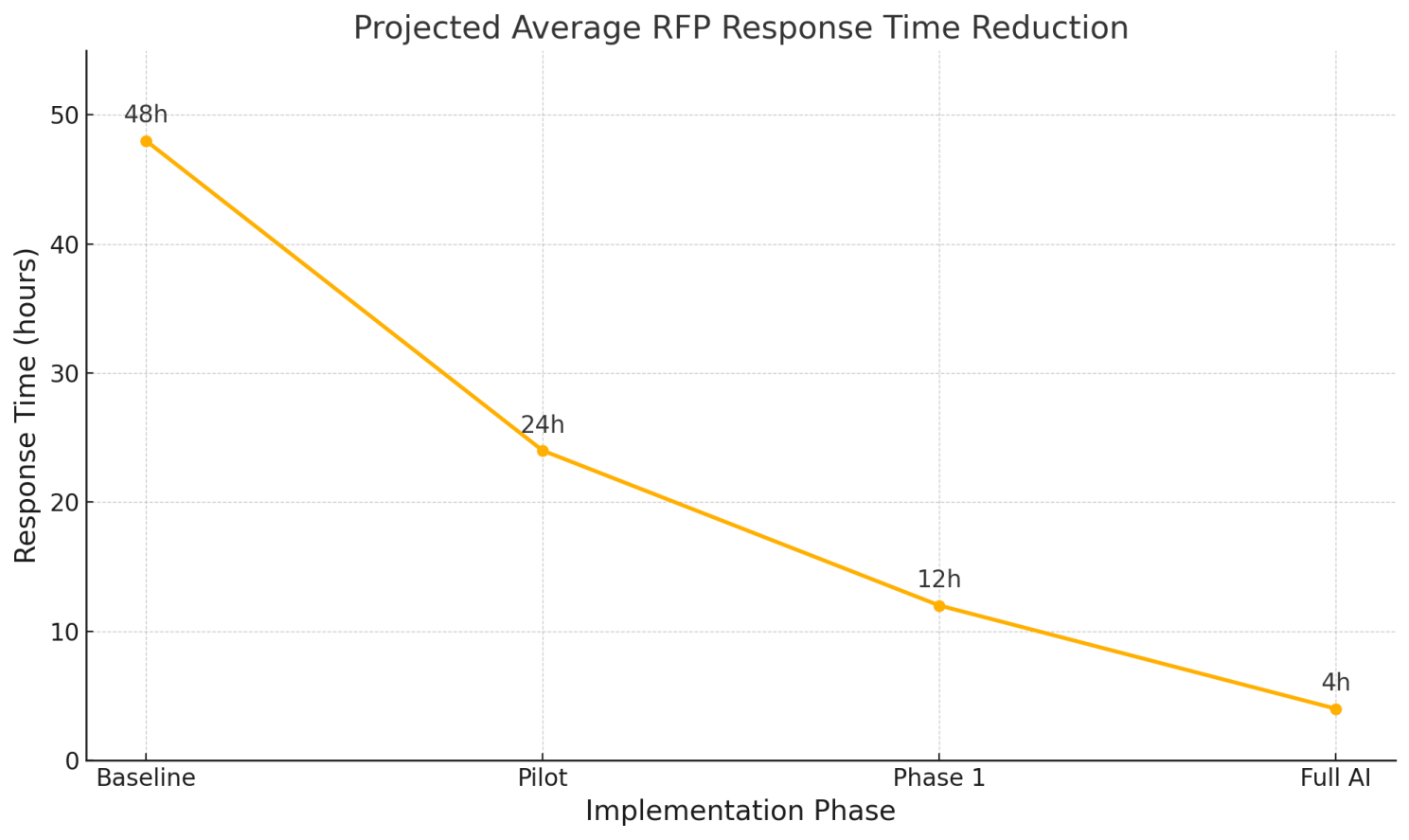
Even early on, results were promising. In a controlled pilot, we had the AI respond to a batch of real RFPs. The first drafts that used to take a proposal writer 5–8 hours to prepare were generated by the AI in about 2–3 minutes. Of course, human review and customization were still needed, but this automation freed up roughly 30% of the team’s time each week that was previously spent on tedious writing and research. Instead of scrambling to meet a two-day deadline, the sales team could iterate and send polished proposals the same day the RFP arrived. Essentially, the AI became an ever-ready proposal writer working at lightning speed.
Industry research backs up these kinds of gains. In one example, a company leveraging AI for proposal management was able to accelerate their response time 10-fold and submit 67% more proposals, simply by trusting the tool to handle initial drafts and content lookups (Responsive Named Leader in Aragon Research Globe for Strategic Response Management, 2025). Our project’s projections were similarly ambitious. We estimated the hotel group’s average response time would drop from 48 hours to under 4 hours within the first few months, and potentially to near-instant answers (under an hour) for many standard queries once the AI was fully trained on more scenarios. This is a game-changer: not only would it delight prospective clients with quick replies, but it also enables the company to juggle more inquiries without burning out staff.
Importantly, faster doesn’t mean sloppier. We put measures in place to ensure quality remained high. The AI’s answers were cross-checked against the knowledge base for accuracy, and we established an approval workflow for sensitive sections. This aligns with best practices elsewhere – for example, Microsoft’s internal proposal AI had to be configured to quote certain answers verbatim (word-for-word from approved text) for compliance (How Microsoft uses AI for RFP management | TechTarget). By tracking metrics like content relevancy and error rates, we maintained confidence that speed didn’t compromise quality. After a few rounds of tuning, the proposal team began to trust the AI’s outputs – which ironically further sped up the process (less time spent double-checking every line). As one team member joked, “We started treating the AI like a new hire who never sleeps but still knows our playbook by heart.”
Scaling RFP Volume with AI Assistance
Faster responses naturally lead to the ability to handle a higher volume of RFPs per week. Before AI, the team often had to pick their battles – sometimes even passing on RFP opportunities when the workload was too high. Now, with much of the heavy lifting automated, they could respond to more leads without adding headcount. Let’s quantify this with an example. Suppose the sales team previously managed about 9 RFP responses in a typical week. With AI assistance, that number could jump to 15 or more in the same timeframe, roughly a 67% increase in throughput.
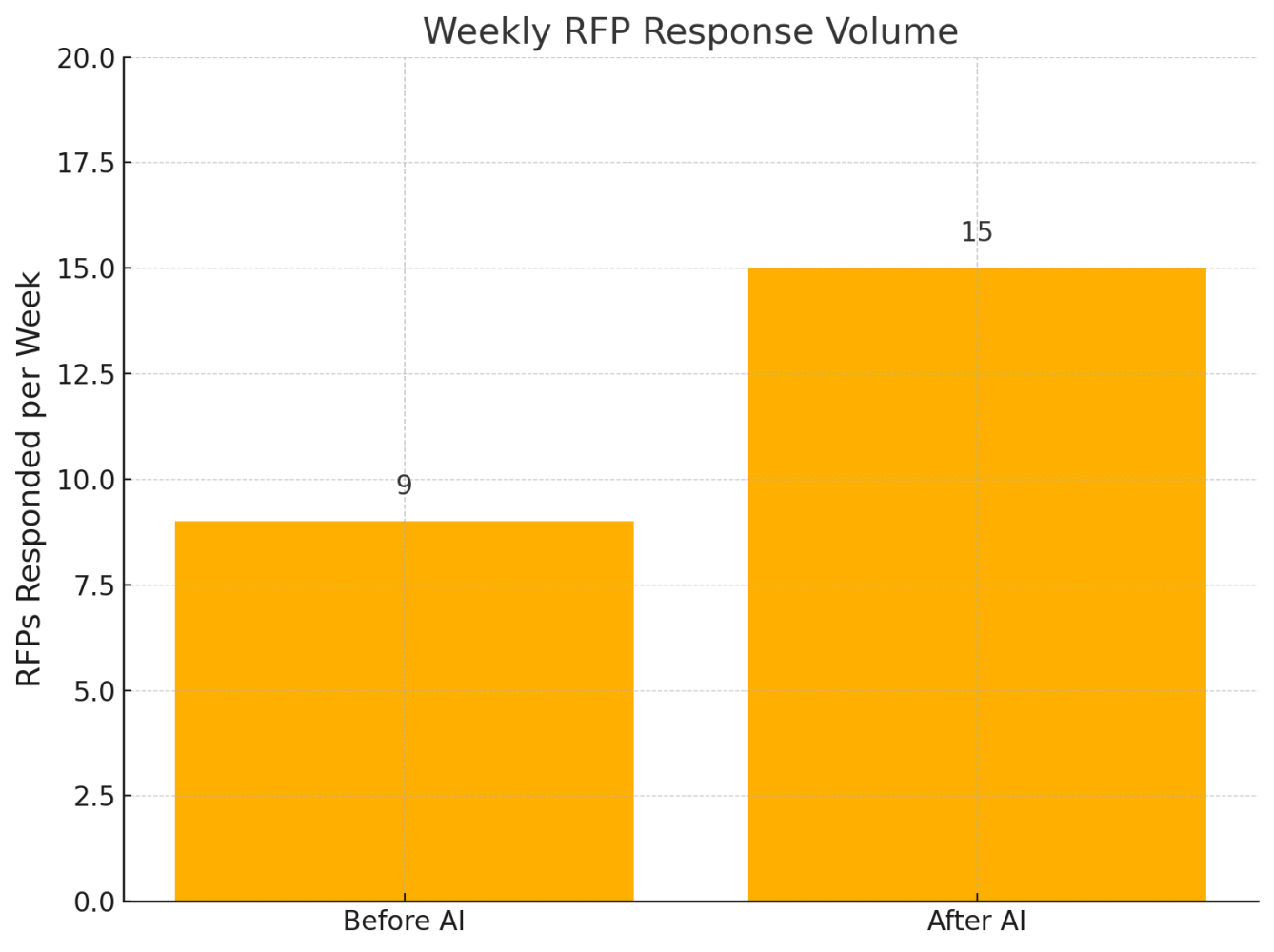
Comparison of how many RFPs the team can respond to per week, before vs. after AI implementation. With AI handling drafting and research, the team’s weekly RFP output is projected to rise significantly (e.g. from 9 to 15 in this illustration), in line with reported gains from AI-enabled proposal teams.
This isn’t just theoretical. As noted earlier, organizations using AI for proposal management have submitted 67% more proposals after adopting the technology (Responsive Named Leader in Aragon Research Globe for Strategic Response Management, 2025). Even mid-sized teams are seeing their RFP counts climb. Loopio’s annual trends report highlighted that proposal teams in 2023 were responding to more RFPs – an average of 175 per year, up from 162 the year prior – despite tighter budgets. The reason? Efficiency improvements and smarter process management. In our hotel’s case, by automating repetitive tasks, the sales folks could reallocate their time to high-value activities – customizing proposals for big deals, following up with clients, and refining content for even better answers. AI took care of the grunt work, which meant no RFP had to be left on the table due to bandwidth.
It’s also worth noting the potential revenue impact of handling more RFPs. More responses sent equals more chances to win business. One AI RFP tool provider reported a customer doubled their RFP response volume and saw a ~20% increase in win rate as a result (Responsive Named Leader in Aragon Research Globe for Strategic Response Management, 2025). While our project is still too recent to boast win-rate statistics, the hotel’s executives are optimistic that responding faster (while maintaining quality) makes a strong impression on potential clients. At minimum, an AI-assisted workflow ensures the company is never disqualified just for missing an RFP deadline, which was a real risk in the past. Now they often beat the deadline by days – or as one executive happily noted, “we sometimes send a proposal before the competition even confirms receipt of the RFP.”
Policy Alignment & Emerging Roadblocks
Even before writing a single line of code, we surfaced several policy and governance challenges that organizations commonly face—and that we needed to address in our design:
- Unclear AI usage policies. Many companies haven’t yet updated their data governance frameworks to explicitly cover generative AI. Teams asked: “Can we feed client emails or PII into this system?” and “What clauses in our vendor agreements cover AI processing?” Without clear guidance, any pilot risks getting stalled by legal or procurement reviews.
- Fear of “black-box” outputs. Stakeholders worry that an AI assistant might hallucinate or contradict brand standards. If a proposal draft contains unvetted language, it can introduce compliance or reputational risks and trigger multiple rounds of rework. This mirrors concerns raised by Paul Roetzer about transparency in AI-driven marketing tools: when users understand how suggestions are generated, trust grows.
- Data residency and training concerns. Even with private-tenant deployments, questions remained: “Who in our organization owns the training data?” and “Must we purge AI logs to meet retention policies?” These uncertainties can prevent security teams from signing off on a production rollout.
Data Privacy & Security
RFPs and proposals contain sensitive information (pricing, client details, etc.), so we needed guarantees that this data would not leak or be used to train any external AI. Our solution was deployed on Azure, leveraging Azure OpenAI in a manner such that all data stayed within the hotel’s cloud tenant. No prompts or responses were sent to public AI endpoints. We also used encryption and strict access controls: only authorized team members could invoke the AI, and all interactions were logged for auditability.
These measures mirror best practices from large enterprises—Microsoft’s internal review mandated security, responsible AI, and accessibility audits before their proposal AI went live. We ran our prototype through pen tests and ensured it met the company’s security standards, demonstrating that AI can be used without sacrificing confidentiality or violating regulations.
Internal Policy Constraints
Initially, there was hesitation because the company policy didn’t explicitly allow generative AI tools. This meant stakeholders asked tough questions about data handling and compliance. Rather than convening formal committees, we addressed these concerns directly in our design:
- Data minimization & anonymization. Only essential fields (e.g., property specifications, quoted rates) feed the model. Names and other identifiers are masked in system logs.
- Controlled knowledge base. The AI draws exclusively from vetted, brand-approved documents—eliminating “hallucinations” and ensuring every suggestion cites its source.
- Human-in-command workflows. No draft ever goes to a client without an explicit “Approve & Send” action by a designated manager, ensuring compliance and quality.
Echoing the customer-centric perspective of Tiffani Bova, we framed these workflows to empower employees: the AI enhances productivity but always requires human judgment at critical steps.
By embedding these guardrails into the system’s architecture and rollout plan, we transformed policy questions into design requirements, ensuring the AI assistant could accelerate RFP workflows without tripping over governance hurdles.
Takeaways and Insights for Leaders
For C-level and senior leaders considering AI to enhance RFP or proposal workflows, our experience offers several key insights:
- Speed Matters – and It’s Attainable: AI can collapse response times from days to hours or minutes, which in turn lets your team seize more opportunities. In sectors like hospitality, where nearly half of clients expect a reply within 48 hours (MICE sourcing volume on track to exceed pre-pandemic numbers by more than 17% ), this is a competitive differentiator. Early adopters are already seeing these benefits – internal data and case studies show dramatic reductions in drafting time (even up to 95% time saved on first drafts). Faster responses not only impress clients but also allow your organization to handle greater volume without additional staff.
- Leverage Existing Platforms for Adoption: Integrate AI into the tools your teams already use (e.g., Teams, Slack, CRM systems). Our project’s success owed a lot to meeting users where they work. An AI assistant in a familiar chat interface meant higher adoption and engagement. The technology can be platform-agnostic – what matters is that it’s easily accessible during the team’s normal workflow. By embedding the assistant in Teams, we removed friction and got people to actually use it.
- Quality and Personalization Remain King: Automating 80% of a response is powerful, but the last 20% – the human touch – is what wins deals. Ensure your AI uses curated, up-to-date content so that the first drafts are high quality, then let your experts refine the nuances. Maintain a review process to catch any issues. With those guardrails, teams can safely accelerate proposals while preserving accuracy and a personal tone. In our case, not a single AI-assisted proposal went out the door unchecked, and that check is what kept the output client-ready.
- Address Security & Governance Early: Engage your security and compliance stakeholders from day one. Choose solutions that keep your data secure (e.g., private cloud deployments, data encryption, audit logs) and be transparent about how the AI works. We learned that demonstrating compliance with internal policies and industry regulations is critical to avoid delays. (Microsoft, for instance, had to delay their AI RFP tool launch by a few weeks to satisfy strict internal reviews (How Microsoft uses AI for RFP management | TechTarget).) Proactively building privacy, security, and responsible AI considerations into your project plan from the start will save headaches later and build trust in the solution.
- Empower Your People – Don’t Replace Them: Position the AI as an assistant that augments your proposal team. This framing encourages adoption and alleviates fears. Invest in training your staff to work alongside the AI, interpreting its suggestions and correcting its mistakes. Over time, your team will develop an intuition for when to rely on the AI and when to step in. In our project, proposal managers became excited to “coach” the AI, treating the knowledge base tuning as a part of their job. This co-pilot approach can boost morale, as employees feel they are gaining a smart teammate rather than being graded by a robot.
Conclusion
The journey from a 48-hour turnaround to real-time RFP insights has been eye-opening. By harnessing AI, the mid-sized hotel group envisioned transforming a cumbersome process into a strategic advantage – responding to clients faster, handling more proposals, and freeing talented staff to focus on what matters. Most importantly, this was achieved with careful attention to data security and without losing the human element that makes each proposal resonate. For executives in hospitality, tech, sales operations, and beyond, the message is clear: AI can be a powerful ally in proposal management, but success depends on aligning it with your people, processes, and policies. As RFP volumes rise and competition stiffens, those who leverage AI thoughtfully will be poised to win more business in less time, turning operational efficiency into tangible growth. The future of RFP responses is real-time, and it’s here now if you’re willing to embrace it.