
From Millennia to Minutes: How Quantum Computing and AI Are Collapsing the Timeline of Human Discovery
The story of human progress is a story of fighting constraints. For millennia, the biggest bottleneck to our development wasn't a lack of intelligence, but a failure of information preservation and transfer.
Knowledge existed only in memory. When an elder passed, decades of hard-won insights vanished. Without a way to preserve knowledge across generations, progress was cyclical, not cumulative. Humanity’s path to exponential growth is marked by successive breakthroughs that removed these fundamental constraints, creating an Exponential Stack of capabilities.
The Phases of Cognitive Constraint Removal
Our history can be viewed through the lens of overcoming specific information bottlenecks:
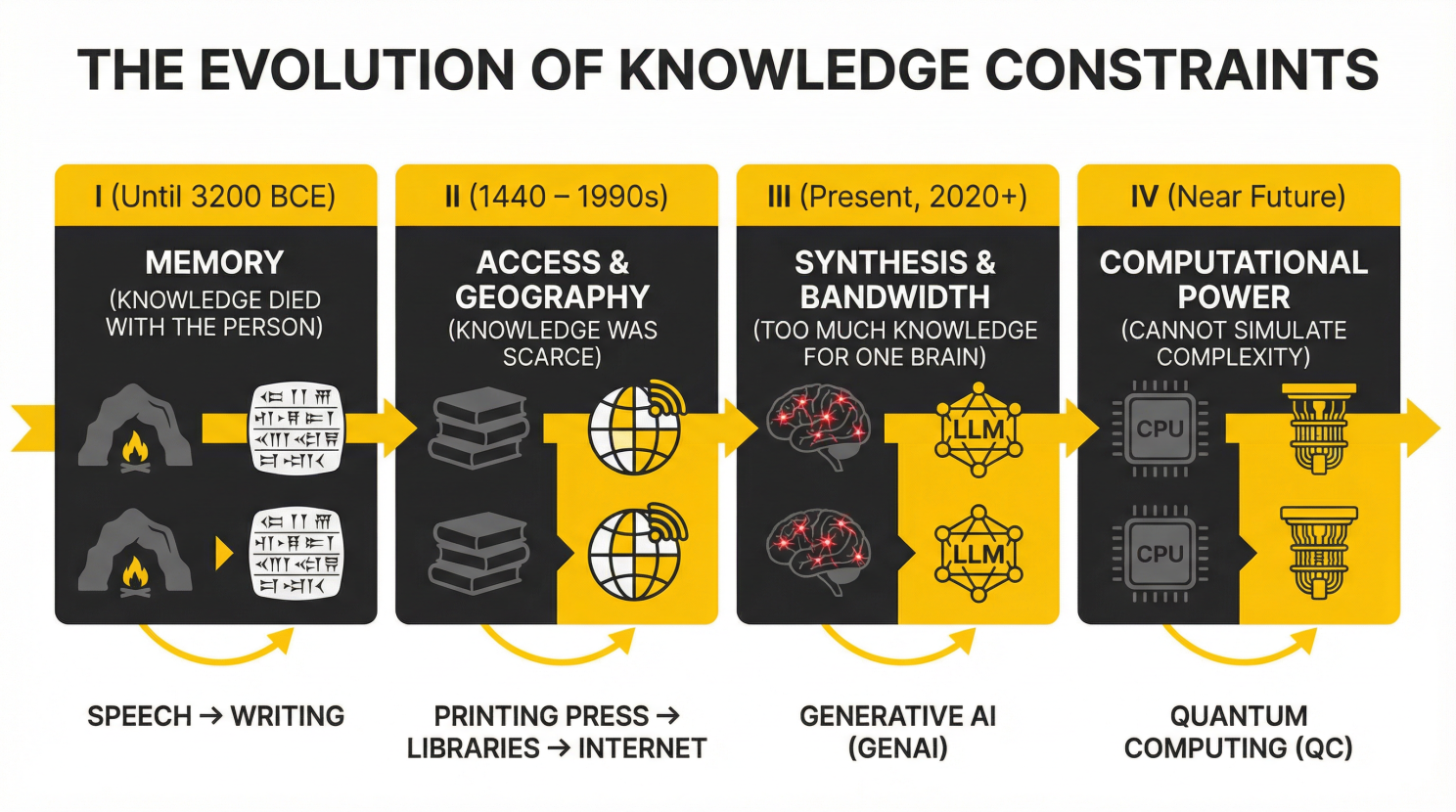
Phase 1: Overcoming the Memory Constraint (The Spoken Word & Writing)
Early humans developed speech, which enabled the generation and sharing of complex ideas, a significant leap. However, speech offered no preservation mechanism; knowledge died with the speaker.
The invention of writing (c. 3200 BCE) solved the Memory Constraint. For the first time, knowledge outlived its creator, becoming cumulative. The new problem became Access. Knowledge was scarce, locked away in specialized libraries, accessible only to a tiny elite.
Phase 2: Overcoming the Access Constraint (Printing & Internet)
The Gutenberg printing press (1440s) shattered the Access Constraint by massively democratizing distribution, enabling the Scientific Revolution. Still, knowledge remained geographically bound.
The Internet (late 1990s) eliminated geography, giving billions universal access to humanity’s collective knowledge base. Problem solved? Not quite.
The Biological Wall: Individual Cognitive Bandwidth
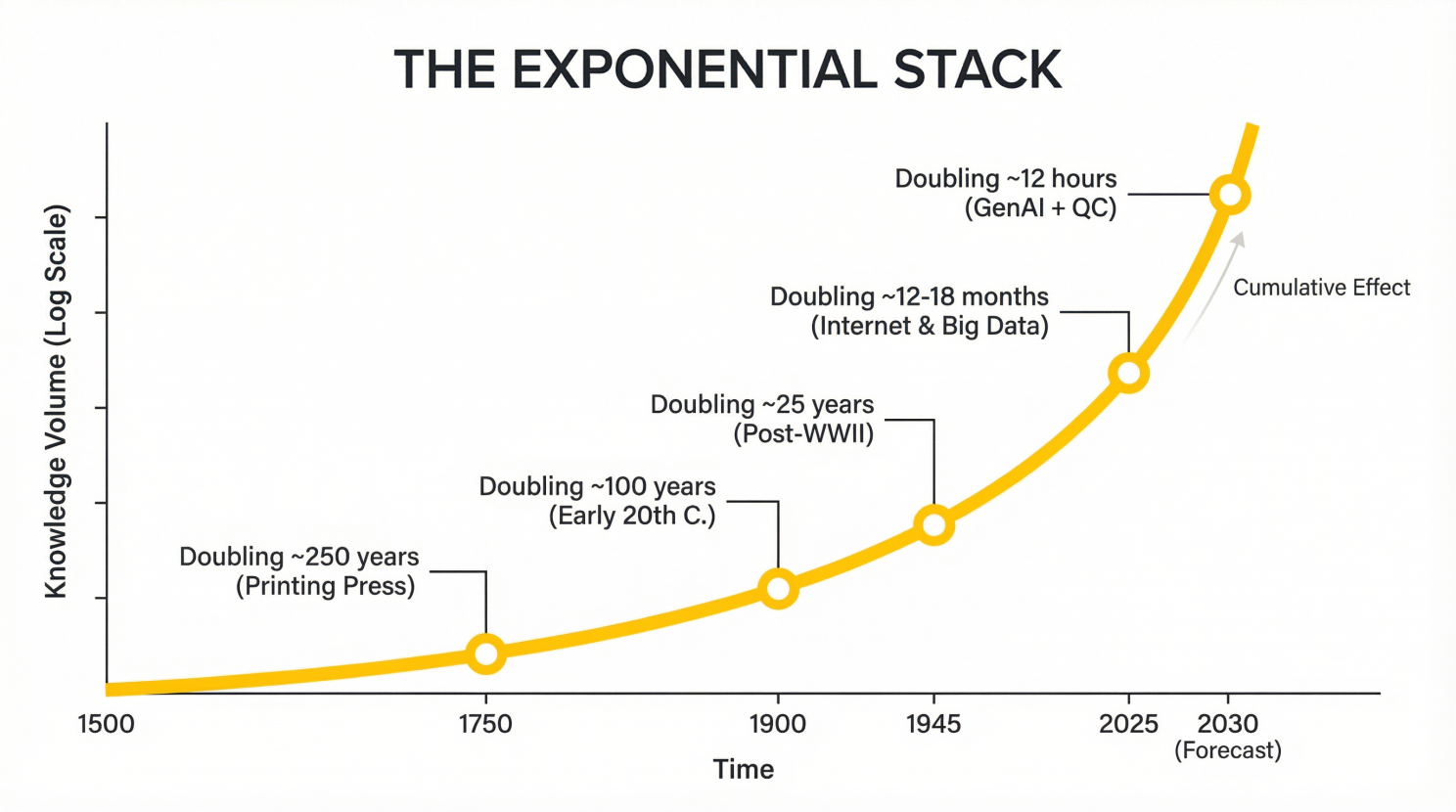
The new constraint is our own biology. The sheer volume of knowledge is exploding — specialized knowledge is estimated to be doubling every 12 to 18 months.
The paradox is profound: We have accumulated more knowledge than any single human can master, yet the greatest discoveries often emerge from finding unexpected connections between disparate fields. This specialization creates silos. We've reached our maximum cognitive capacity. The total volume of potentially relevant information simply exceeds what a single human brain can process and synthesize in one lifetime
The Next Two Steps: Breaking the Cognitive and Computational Walls
Step 1: Breaking the Synthesis Constraint with AI
Generative AI (GenAI) is the solution to the Synthesis Constraint. For the first time, we have created an entity that can ingest and process knowledge across all domains simultaneously (medicine, physics, chemistry, engineering). It identifies patterns and correlations that no human specialist would ever see because no human could read and synthesize that volume of information across disciplines.
AI acts as a cognitive co-pilot, matching the breadth of human collective knowledge and making it instantly actionable for the individual practitioner.
However, AI still faces the ultimate limitation: computational power. Complex problems, like simulating molecular interactions or optimizing vast networks, remain fundamentally intractable for even the fastest classical computers.
Step 2: Breaking the Computational Constraint with Quantum Computing
Quantum Computing (QC) doesn't just make calculations faster; it changes what is computable.
By using qubits in superposition, QC can explore vast solution spaces exponentially faster for specific problem types. This fundamentally changes the math for complexity. IBM's quantum systems are already in use, performing quantum-classical hybrid simulations in drug discovery, modeling molecular interactions beyond the practical reach of classical supercomputers.
QC provides the power to test possibilities that AI synthesizes.
The Exponential Convergence
The ultimate acceleration happens when these two steps converge: AI solves the Knowledge Synthesis Problem, and Quantum Computing solves the Computational Problem.
This convergence is cumulative. Each breakthrough multiplies the previous one: The Internet made AI possible; AI will make Quantum Computing effective by helping us understand and apply its complex outputs.
- Quantum Machine Learning (QML) offers theoretical exponential speedup for critical optimization tasks.
- Quantum-enhanced generative models can create novel molecular candidates that classical systems cannot explore.
This convergence means scientific and industrial progress will accelerate exponentially.
Business Perspective: The New Pace of Change
This dramatic collapse in the timeline of discovery has one critical implication for leaders: the pace of change itself is changing.
Industries that felt stable for decades will transform in years. Competitive moats based on historical knowledge or slow-moving processes will quickly erode. The tools to reinvent entire fields are being deployed right now.
As someone building AI solutions for enterprise challenges (at ApolloRise, for instance), the focus is no longer on simply automating tasks but on removing fundamental constraints that limit human decision-making. The ability to simulate complex scenarios and synthesize cross-domain knowledge will move from being a competitive advantage to a necessary operational baseline. The next decade will see unparalleled progress, not because we're suddenly smarter, but because we've finally removed the constraints that limited progress for 10,000 years.
My thanks to Alessandro Curioni and George Tulevski of IBM. Their presentations on the quantum roadmap were a powerful catalyst for these reflections.
#QuantumComputing #ArtificialIntelligence #Innovation #IBM #TechnologyTrends #DigitalTransformation #FutureOfWork #DeepTech #ApolloRise