
AI and the Slow Fade of Professional Skills
Today, the question of AI outperforming humans arises across various industries. Healthcare, finance, logistics, law, and engineering. The pattern repeats. I don’t want to walk past it. This is important, and it affects all of us.
Recent studies point to a clear trend. In controlled experiments, AI systems often deliver more accurate results than individual experts. A large meta-analysis published earlier this year found that while human-AI teams usually outperform humans, they rarely exceed the AI system itself.
That reality brings us to an uncomfortable point. What happens to our skills when we start outsourcing parts of our thinking to AI?
This is not hypothetical. I’ve felt it personally. Over the last three years, I’ve used AI in almost every part of my work: writing, planning, engineering, and product development. I value the speed and clarity it provides. But I’ve also noticed a quiet shift. Certain things I used to do quickly now take longer when I attempt them without assistance. Syntax feels less automatic. Decisions feel less intuitive.
I want to focus on something that still receives too little attention: The slow degradation of professional skills in the age of intelligent assistance, and practical ways to address it.
Why Skill Decay Happens Faster Than We Expect
Humans adapt quickly to convenience. Our brains love shortcuts. When an external system does the hard part for us, we stop reinforcing deep internal models. Over time, cognitive load migrates to the tool.
Skill decay is subtle. You don’t notice it after a day or a week. You notice it after a year.
Navigation is a simple example. Once smartphones replaced maps, many people lost the ability to recall routes or build spatial intuition. The same dynamic is emerging in knowledge work. AI writes drafts, summarizes complex material, refactors code, generates analysis, and structures arguments. It is a genuine multiplier. But it also relocates effort from the person to the system.
When you stop lifting the weight, your muscles don’t negotiate. They shrink.
Muscles in Microgravity: A Powerful Analogy
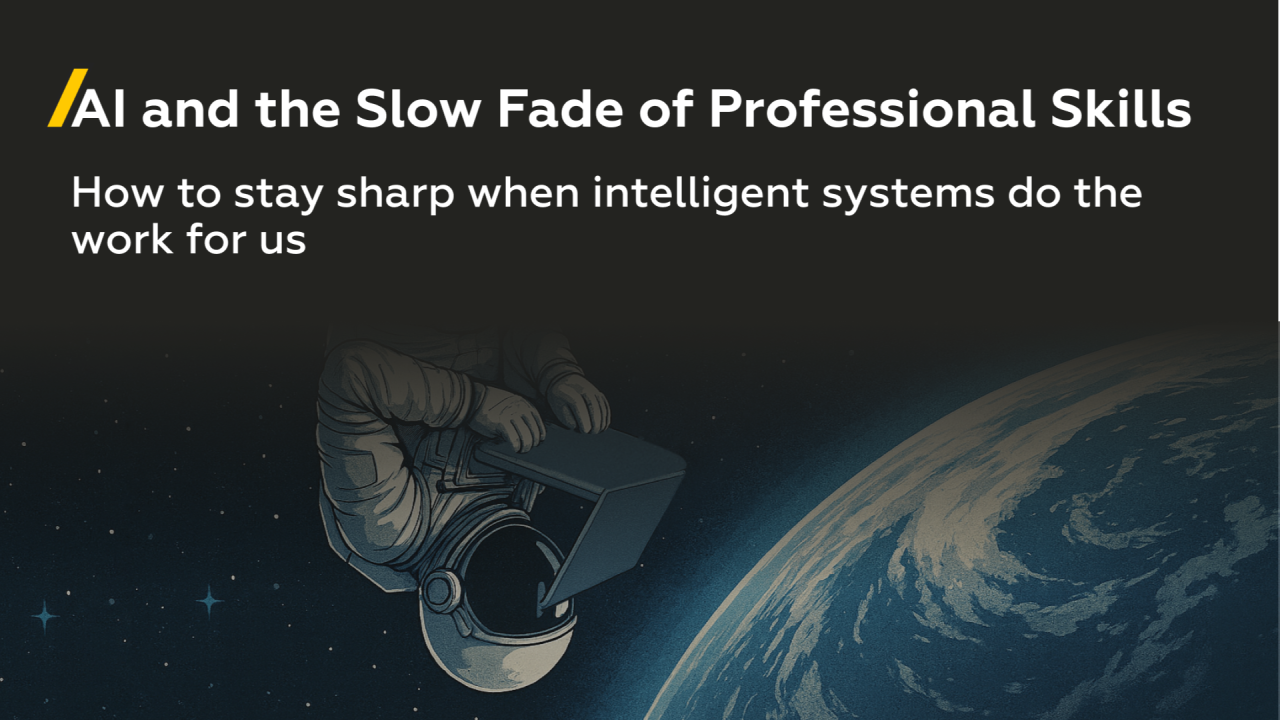
Astronauts lose muscle strength quickly in microgravity. Without gravity doing its usual work, the body begins optimizing away what it no longer needs. To counter this, crews train daily using resistance devices that simulate load.
This maps cleanly to professional skills in the age of AI. We are currently operating in cognitive microgravity.
If a system does most of the heavy lifting for you, your strength fades. Skills that once felt natural become slower, less automatic, and harder to access under pressure. The principle is simple: Without intentional practice, skills decay. Even in high-performance environments.

The Real Risk: Not Replacing Humans, but Weakening Them
The problem is not that AI will replace professionals overnight. The problem is that AI will gradually weaken professionals.
At first, it feels like efficiency. Later, it becomes a dependency. Eventually, it can become a loss of autonomy.
- Teams that rely on AI without structure may lose situational awareness.
- Developers who let AI write everything may stop noticing architectural flaws.
- Analysts who let AI craft conclusions may lose contact with the assumptions underneath them.
At scale, this creates organizations that are fast but fragile.
Building a "Skill Gravity System"
So what is the answer? Not banning AI. Not limiting it by default. The more durable response is to create an artificial load.
In the same way astronauts use resistance training in space, we need structured resistance for cognitive skills. I call this approach the Skill Gravity System.
The idea is straightforward: Use AI every day. But design intentional friction into the workflow.
1. Separate Core Skills from AI Skills
You cannot train everything at once. Select a small set of Core Skills that must not degrade (e.g., architectural thinking, strategic reasoning, debugging). Pair them with AI-Era Skills that must grow (e.g., clear task specification, verification, quality control).
2. Establish Operating Modes
- AI-First: Used for speed and routine tasks. This remains a significant part of daily work.
- Human-First: Attempt a solution independently before you consult AI. This is where retention and growth are reinforced.
- Human-Only: Rarer but essential sessions. Keeps the foundation stable and protects confidence when tools are unavailable.
3. The Rhythm (Practical Baseline)
To avoid turning this into a theory, the system needs a lightweight rhythm:
- Daily: ~20 minutes of human-first work on a small real task.
- Weekly: One session of 60–90 minutes without AI on something slightly above your comfort zone.
- Bi-Weekly: A "Rebuild Session" where you recreate an AI-generated output from scratch to compare approaches.
- Monthly: A brief skill check across 3–5 core areas.
Team-Level Training: The AI Gym

At the team level, the most efficient structure is a weekly format I call the AI Gym.
A small group tackles one practical problem. The first phase is manual. The team documents assumptions and approach. Only then does AI enter the workflow for comparison, acceleration, or alternative reasoning.
The final step is not performance theater but the extraction of lessons:
- What did the humans miss?
- What did the model miss?
- What should become a rule of thumb for the next project?
The New Professionals Will Grow Up in Cognitive Microgravity
One of the deeper implications is generational. Experienced professionals built their foundations in a pre-AI environment. But new entrants will develop in a world where AI is present from day one.
Without structured skill load, they may never form durable internal models. They can become fast but shallow, productive but dependent. This is not an individual failure, it is a design problem in the environments we are building.
If AI is the new operating layer of work, then skill preservation must become a formal part of training, onboarding, and team processes.
Use AI, but Frame It With Load
This is not an argument against progress. It is an argument for intentional progress.
You do not stop driving because you want strong legs. But you still train. You still run. You still lift. You understand that convenience and capability are not the same thing.
Use AI every day. Let it accelerate you. Let it cover the repetitive load. But introduce deliberate friction. Protect your core skills.
Efficiency is useful. Competence is irreplaceable.
The question is not whether AI will define the next decade of work. The question is whether we will define how we work with it.
I am experimenting with this approach personally and in the teams I work with. If you are building a similar system or have insights on skill preservation in the AI era, I would be glad to compare notes in the comments.